

For B2B technology companies, being known for what you sell is important. Being known for what you know can be even more valuable.
That’s the power of thought leadership.
A strong thought-leadership program gives a company a way to stand out in a crowded market, build credibility with the audiences that matter most and shape how prospects think about an issue before they are actively looking to buy. It can also strengthen the company brand in a way that marketing alone cannot.
Instead of simply saying, “Here’s what our technology does,” thought leadership gives companies an opportunity to say, “Here’s what we believe is changing in the market and why it matters.” That shift can have a meaningful impact on buying consideration. Research from LinkedIn and Edelman found that 75% of B2B decision-makers and C-suite executives say a piece of thought leadership has led them to research a product or service they weren’t previously considering.
In other words, thought leadership can put a company on the radar before the buying cycle begins, when prospects are still defining the problem and forming opinions about potential vendors.
Thought Leadership Has a Role in AI Search, Too
There’s another reason thought leadership is becoming increasingly important: the way people find information is changing.
AI search and generative AI tools are changing how prospects research companies, technologies and industry issues. Rather than simply searching for a vendor, buyers are asking questions and looking for information that helps them understand a problem. That creates an opportunity for companies that have a strong point of view and something useful to add to the conversation.
AI-generated answers draw on information that exists across the web, including credible earned media, expert commentary and third-party sources. A well-developed thought-leadership program can help put a company’s expertise into those sources.
This is where PR and thought leadership intersect. A strong point of view can become a contributed article, generate media interest, lead to executive interviews or provide the foundation for an expert quote in a story. Those third-party mentions build traditional brand visibility and they add credibility and help establish the company and its executives as knowledgeable sources on a particular topic.
The goal isn’t to “game” AI search. It’s to earn the visibility and credibility that AI search increasingly draws upon.
What Makes Thought Leadership Work?
Not every executive article or LinkedIn post qualifies as thought leadership. The difference is usually in the idea behind it. Strong thought leadership goes beyond describing what is happening in the market to offer a perspective on why it matters, what others may be missing or what might need to change.
That perspective should be grounded in something real. Proprietary data, customer experience, technical expertise, research and firsthand market observations can all give an idea more substance and credibility. The strongest pieces give the audience something to think about, not simply something to agree with.
Consider the difference between saying, “Companies need to adapt to the rapid pace of technology change” and taking a stronger position: “The organizations that adapt fastest to technology change may not be the ones that move fastest. They may be the ones that have built the discipline to decide what not to change.”
Another example is “AI is transforming the data center” and taking a stronger position: “The data center is no longer being designed simply to process information. It is becoming an AI factory – an infrastructure system built to turn data into intelligence.”
In both examples, the second idea gives the audience something to explore and debate. And that is where thought leadership starts to become more than content.
What Makes Thought Leadership Different
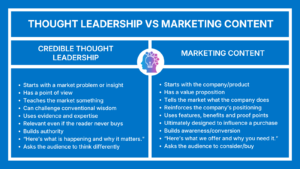
Thought leadership starts with an issue, insight or point of view that is valuable to the audience, whether or not they ever become a customer. Marketing content starts with the company and what it offers. Both have an important role, but they should not be confused.
This distinction is at the heart of building thought leadership that actually earns credibility and authority in the market.
Keep It Non-Promotional
This is one of the most important (and often overlooked) qualities of good thought leadership.
The objective is not to disguise a product pitch as an article. LinkedIn and Edelman research reinforces the point: 73% of B2B buyers say thought leadership is a more trustworthy basis for assessing a company’s capabilities and competencies than marketing materials and product sheets.
That makes sense. Good thought leadership gives the audience something of value before asking them to buy anything. It can establish expertise and credibility without turning every insight into a reason to talk about the company’s product.
Non-promotional doesn’t mean completely company-neutral. A company’s expertise, customer experience and proprietary knowledge should inform its point of view. But the idea needs to be bigger than the product.
Think Beyond the Article
Thought leadership also doesn’t have to live in a single article or a single channel. A strong idea can create opportunities for broader conversations, from executive social content and media discussions to podcasts, speaking opportunities and other industry forums.
That’s where thought leadership can become more than another content exercise. The goal isn’t simply to produce more content. It’s to build recognition around what your company knows, what it believes and where it sees the market going.
Don’t just tell the market what your company does. Give your audience a reason to think differently and become known for the ideas that move the conversation and the market forward.